Lucas Cuny’s “Inland Empire” Screens Free in Redlands Feb. 18 as $25K Feature Crowdfunding Deadline Nears
4 min read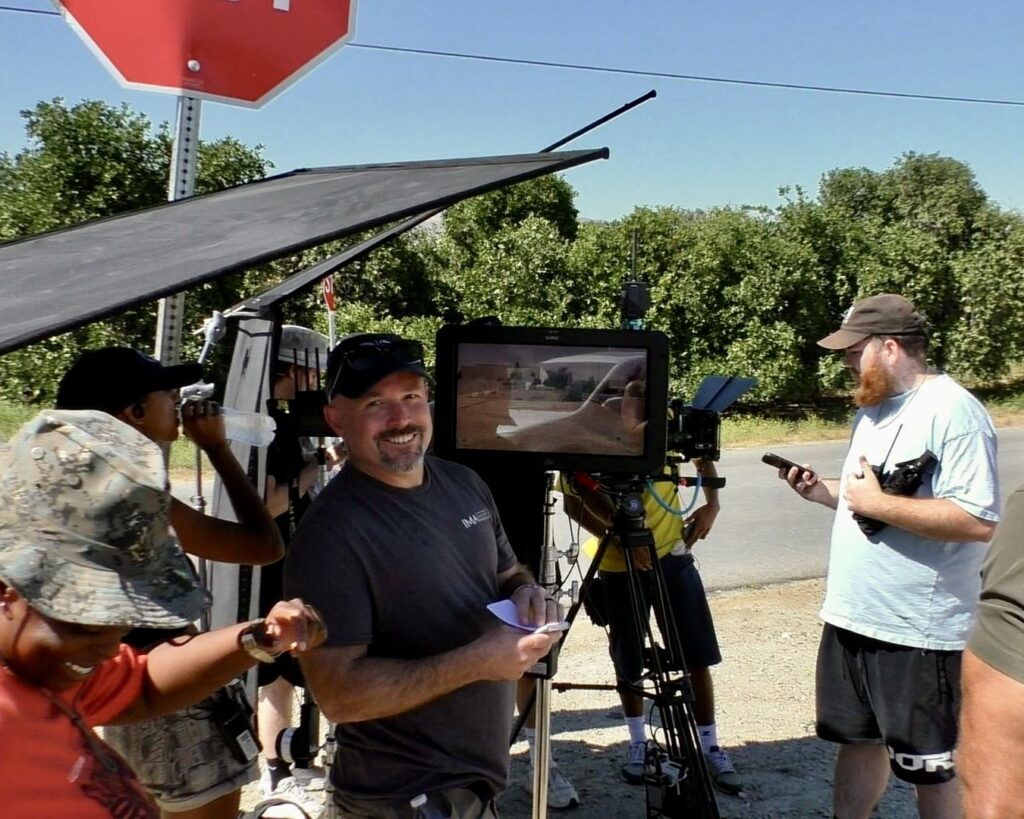
Lucas Cuny, center, confers with his crew while filming orange grove scenes in Redlands last summer for his proof-of-concept short film The Inland Empire.
Inland Empire filmmaker and San Bernardino Valley College film department chair Lucas Cuny will host a free public screening of his anticipated indie short-film, The Inland Empire, at Ritual Brewing Co. in Redlands on Wednesday, Feb. 18, using the event as a launchpad to crowdfund a feature-length expansion of the story.
The event begins at 7 p.m. at Ritual Brewing Co., 1315 Research Dr., with the screening expected to start around 7:30 p.m., Cuny said. Tickets are free through Eventbrite.
Cuny described the seven-minute film as a “proof of concept” — “an elongated trailer, if you will” — designed to show audiences the tone and potential of a longer project. “The film is about seven minutes long. We’ll have QR codes ready with our donation link at the screening,” he said.
The feature version is already written, Cuny said, with a goal of roughly 90 minutes. “Ready. It’s ready to go…ish,” he said. “It’s just about funding at this point.”
Cuny said the film is scripted and centers on a bail bondsman drawn into a case that begins in the region’s citrus landscape. “It centers on the main character’s bail bondsman,” he said. “And there’s a murder mystery that starts in the orange groves.” The bondsman is searching for a client who is accused of being involved in the death of a homeless person, he said, and “as the bondsman’s trying to find him, he uncovers a bigger mystery, which is a whole sex trafficking ring going on at a church.”
Cuny called the project a “neo noir,” describing it as “those old 1940s and 50s detective movies,” and added, “It’s Chinatown for the Inland Empire.”
The short version was filmed last summer over two days, Cuny said, with Redlands locations including parts of the Orange Blossom Trail, exterior shots outside the Redlands Police Department building downtown, and a grove-like setting created at a park near the Grove School and the Barton schoolhouse. “We shot there because they have a couple rows of orange groves next to the street,” he said.
Cuny said Redlands has been supportive of small productions. “Every time I’ve shot projects in Redlands, the city and Redlands PD has been great to work with,” he said.
The film also doubles as a hands-on training ground tied to Cuny’s teaching role at San Bernardino Valley College. Cuny said the short film’s cast and crew drew heavily from students and faculty, and the feature would expand that model. “It’s all students and fellow faculty at Valley College,” he said.
He said the fundraising goal is $25,000, with money intended for locations, actors and paid opportunities for students working in key crew positions. “These funds will go towards paying for more locations, the actors, and paying students to work on the crew for the feature length film,” he said.
Cuny said the student roles would not be symbolic. “Well, they’re not just going to be getting coffee on it,” he said. Students will fill “key roles in the camera department, in the audio department, in the production department,” and he listed positions such as assistant camera, second assistant camera, gaffer, key grip and “best boy electric.” He added that post-production would also include student assistant editors.
The premiere is also tied to a broader argument Cuny has made about the Inland Empire’s economic future — and the region’s limited investment in media infrastructure compared with its growth in logistics and warehousing.
“We should have been Albuquerque, New Mexico as a region,” Cuny said, arguing that film and television can be a “more viable long term economic sector than warehousing.” He framed the choice in blunt terms, “Do you want an Amazon warehouse or would you rather have an Amazon studio? I’d rather have an Amazon studio.”
Cuny also criticized what he described as a lack of aggressive outreach from local leaders to attract studios, stages and broadcast investment. “Politicians in the Inland Empire lead from behind. And I say behind. I’m talking like miles behind,” he said. He added, “I don’t know how you can be an hour away from the entertainment capital of the world and not have a studio out here, not have a post production facility out here, not have an animation studio.”
As a practical pitch, Cuny said the Inland Empire’s value proposition includes lower permitting costs and more space than Los Angeles. “Do you want to save money on daily permit rates? Then you should be filming out here,” he said, estimating that a daily rate locally could be “anywhere from $50 to $200 a day,” compared with “about $2,000” a day in Los Angeles.
At the Feb. 18 screening, Cuny said attendees will have an opportunity to donate and, at certain levels, receive an on-screen credit.
Cuny said his deadline to determine whether the feature can move forward is March 10.
For more information on the crowdfunding campaign, visit Lucas Cuny’s “Inland Empire — A Feature Film” Kickstarter page here.