California Candidates Court Inland Empire Voters on Housing, Healthcare, Labor and Wealth Divide at SBVC
5 min read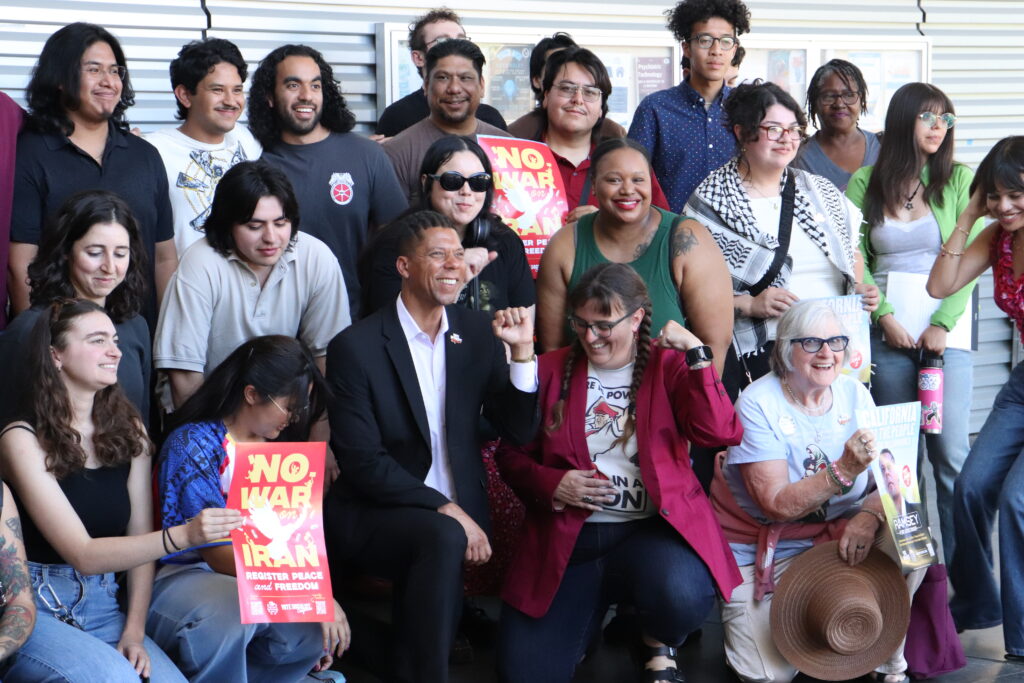
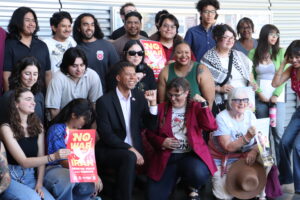
Photos by Christopher Salazar: Peace and Freedom gubernatorial candidates brought their message on housing, healthcare and the wealth divide to Inland Empire voters at a regional campaign stop.
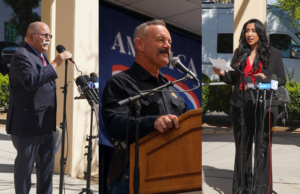
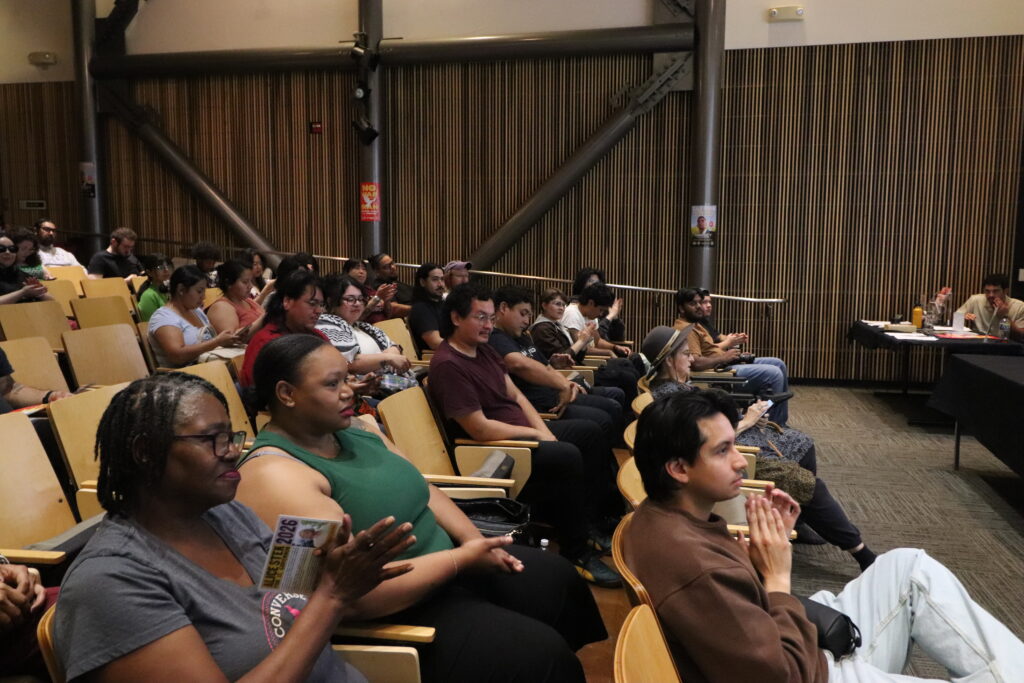
Curious Inland Empire residents grappling with class tensions congregated at the San Bernardino Valley College Library to meet California gubernatorial candidate Ramsey Robinson and state controller candidate Meghann Adams on Saturday, April 4. Running on the Peace and Freedom Party ticket, Robinson and Adams, alongside Party Chair Kevin Akin, pitched socialism as a bulwark against status quo Democrats, Republicans and a capitalistic system they say serves the billionaire class at the expense of the common good.
As the crises of climate, housing, health and wealth disparities converge, Inland Empire voters wrestle over growing concerns of economic and political agency. The so-called ‘land of cheap dirt’ is the nation’s logistics capital: 40% of U.S. imports and consumer goods pass through the region in route from their foreign, domestic or online sources to their final destination, generating over 600,000 daily truck trips and air pollution that disproportionately affects minority communities. For Robinson and Adams, the Inland Empire has been “deeply exploited” and they seek to shift economic and political power from the state’s wealthy, corporate and legislative elites to the working class.
“Politics is the arena for the struggle of power, and power is the means to accomplish our goals,” Robinson said. “We want oppressed people and working class people like us to have the power.”
Robinson, a longtime organizer and mental health social worker who described his own experiences living paycheck to paycheck while facing housing instability, framed his campaign as rooted in lived experience rather than political ambition. He pointed to what he described as systemic inequities, including wage theft, rising evictions and the high cost of living, as evidence that California’s economic and political system disproportionately benefits the wealthy.
On housing, Robinson proposed invoking the California Emergency Services Act to freeze rents, halt evictions and expand housing through public intervention, including the use of eminent domain to acquire properties held by corporate landlords like Blackstone Inc.
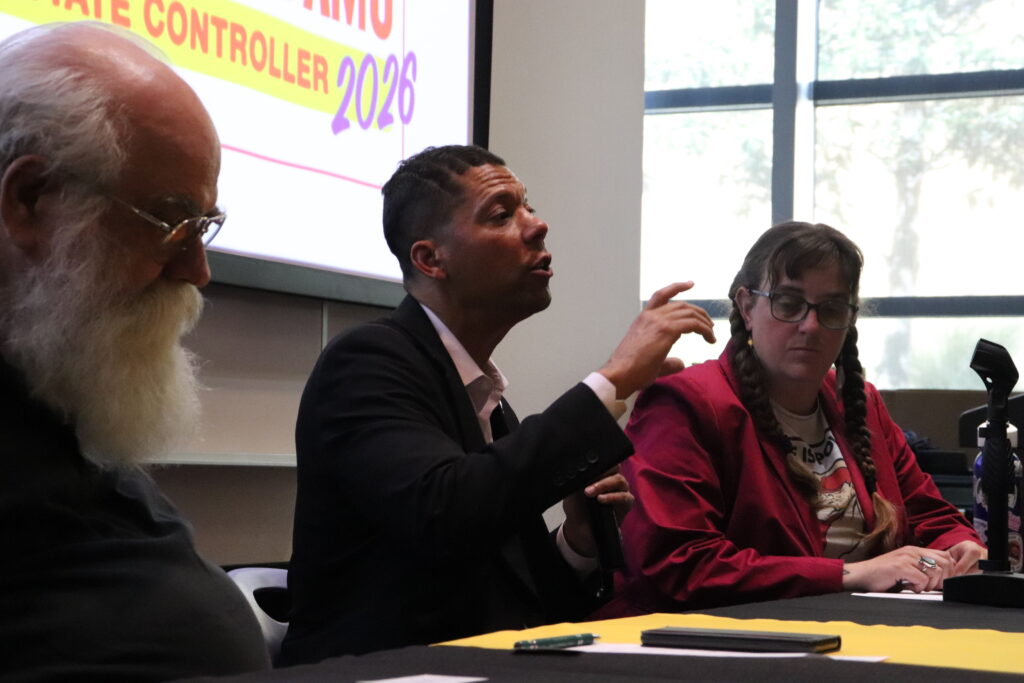
“Let’s put these people on blast,” he said. “In particular, Blackstone snatched up 15,600 homes, [then] they sit on them, drive up the rent, evict folk like us and then pocket the money.”
Robinson also called for guaranteed union jobs paying at least $30 an hour and expanded public infrastructure to shift economic control towards workers, stressing the importance and asymmetry of warehouse labor, earnings and wealth generation in the region.
“They’re responsible—not the bosses, not Jeff Bezos—but the warehouse workers are responsible for moving 40% of consumer goods throughout the whole nation,” Robinson said. “Yet their average income is only $29,000 a year,” adding that they’re “barely surviving” while “generating wealth” for those “at the top,” citing the difficulty of raising a family in California when “child care is $22,000 a year.”
According to the Bureau of Labor Statistics (BLS), the national median income for non-supervisory warehouse workers earns about $37,000 annually, with forklift operators on the higher end at $45,000. However, the bottom 10% of laborers, many of whom are part-time or temporary, earn roughly $29,000 annually.
Still, of the 1.7 million people employed in Riverside and San Bernardino Counties, one in 15 work in warehouses, earning about 75% of the regional average amid dangerous working conditions and difficulties forming worker-led unions.
Adams, a union bus driver for the San Francisco Unified School District and President of the local International Association of Sheet Metal, Air, Rail and Transportation Workers (SMART) 1741, emphasized the financial oversight role of the office, describing it as way to increase transparency and accountability in state spending, citing that billions of dollars in public funds have been mismanaged.
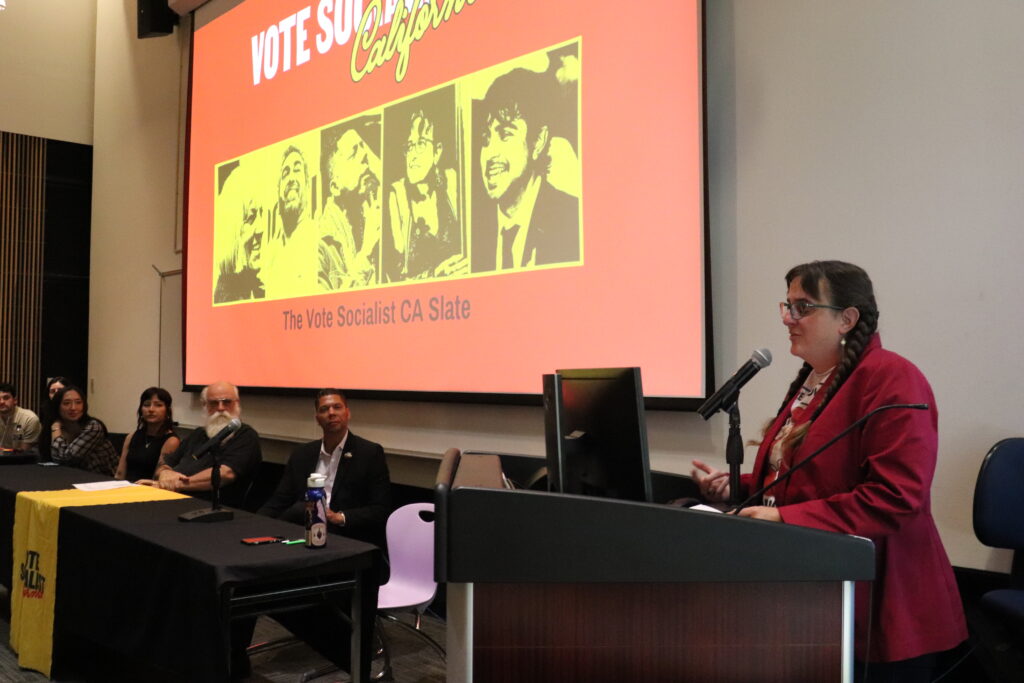
“The state controller, over the last 10 years, has found $10 billion of financial mismanagement and abuse of those who’ve gotten contracts from the state,” Adams said. “And so let’s make a real assessment of not just the budget [as proposed]—but the reality of it—and ask: is that matching what we really want to see?”
She argued that a comprehensive audit could redirect resources toward education, housing and healthcare.
“California is tied with the highest poverty rate in the nation,” Adams said. “There’s absolutely no excuse for this . . . there’s billions being stolen from working people that we could take back and actually fund everything that we need.”
Highlighting her roughly 25-year history of working with the nation’s youth and the influence of her parents who worked as educators, Adams said she wants to help people reach their potential.
“Let’s invest in our future,” she said, noting her AmeriCorps tenure and after school programming to help kids improve in math and science.
For some attendees, the event offered policy proposals but also a sense of political alignment.
Sade Griggs, an Inland Empire resident and healthcare administrator, said she attended the event to hear how candidates would address inequality.
Griggs, who said she switched her party to Peace and Freedom immediately following the event, described Robinson and Adams as relatable and grounded and emphasized why she left the Democratic Party.
“I like to vote for my own interests, and there was nothing that they were doing that helped with the interests of my community—the community I live in, work in, deal with on a daily basis,” she said. “There was no benefit for me, so I needed to leave.”
Others drew connections between the candidates’ platform and ongoing labor struggles in the region.
Juan Mereles, a worker at Amazon’s KSBD air hub in San Bernardino, said his support for the campaign stems from his experience organizing for a union at the facility.
“We had people who can’t pay their bills . . . people who have to drive over an hour, sometimes two to get to work,” Mereles said. “But we stood together and we won our union majority.”
Mereles added that federal delays for union recognition by the National Labor Relations Board (NLRB) and what he described as corporate resistance highlight the need for political leaders aligned with workers’ needs.
“We don’t have people in power who have the interest in us as workers,” he said.
For Robinson and Adams, this underscores their broader argument: economic and political systems in California need to prioritize frontline workers and working class families over corporate interests.
While third-party candidates historically face long odds in statewide elections, Robinson argued that growing dissatisfaction with major parties has opened and enlivened people to political alternatives, adding that the Peace and Freedom Party is growing rapidly.
“We’re not just waging a battle at the ballot box,” Robinson said. “We’re part of a mass movement.”
Whether Robinson and Adams’ vision gains traction remains to be seen. Even so, in a region shaped by warehouse workers who support the nation’s logistical flow while facing environmental strain and rising costs of living, the question is whether political power will follow the labor that sustains it.